
Monastic Living: Find Your Ideal Home for Monks
How does it feel to live a monastic life in a world that moves at breakneck speed? Is it possible to discover a location for the perfect home for monks that embodies spiritual life, simplicity, and community? Monastic living can be a life journey for some, and in finding the perfect place, the home for monks may be a discovery.
Monastic living and working communities are a geographically and psychologically bounded social order built on the principle of living together in contemplation, as well as working and communal living together. In this monastic exploration, some aspects of a home for monks that are freestanding for contemplation, work, and communal living.
Key Takeaways
- Principles of monastic living are understood
- An ideal home for monks is characterized
- The importance of community in monastic life is radically theologically understood.
- The monastic living, and exclusively, will work for spiritual life.
- Identification of a monastic living as developed.
The Spiritual Foundation of Monastic Living
The monastic living shaping community and the traditions of that community, is social order and living modes together dispersed. Monastic communities of a world religion are and a commitment to spiritual life.
The Purpose and Philosophy Behind Monastic Communities
The aim of monastic communities is first and foremost to engage in constructive spiritual growth of the community members. This philosophy maintains that active focus on a spirituality can facilitate a greater comprehension of the self and the Holy. Monasteries permit practitioners of the monastic life to “hide” or more appropriately “retreat” from the everyday secular demands of the world.
Monks follow a regimen of life which integrates a harmonious combination of prayer, meditation, and work. This triad is aimed to facilitate the development of the monk.
How Living Space Affects Spiritual Practice
The arrangement of monastic living quarters is one of the more influential factors in the support and encourage the spiritual disciplines of the monks. Calm and conditioned spatial context allows for meditation and other forms of mental abstraction, and the consequent movement of the mind and heart to the Divine.
Monastic design promotes a greater enactment of the spiritual principles of peace and order. This can be achieved through the incorporation of gardens, chapels, and communal spaces.
Read for More : – new home essentials
The Evolution of Monastic Architecture
The evolution of monastic architecture displays a distinctive blending of the spiritual and the functional. Over the years, monastic dwellings have been adapted to the specific needs of their occupants, serving the spiritual, the cultural, the practical, and the domestic aspects of monastic life or home for monks.
Ancient Monastic Dwellings
As a function of geography and local religious practice, the ancient monastic dwellings of differing religious traditions were quite diverse. For Buddhism, monasteries were built around glued to a meditation. The ancient Buddhist caves at Ajanta and Ellora in India created designed to serve caves and works of architecture and planning and design integration. For Christian monastic communities in Egypt and Syria, the early helped design the landscape of the dwellings.
Medieval Monasteries and Their Design Principles
The order of St. Benedict had a major influence monastic architecture in Europe. Monasteries were built around a central courtyard, or cloister, and the functional ‘active’ parts of the community were arranged around it. The design in structure and layout was to serve, and promote to a certain degree, the and the spiritual life of the community. Abstracting the non-functional elements of the design and layout, the key design features were simplicity, the functional separation of the active and passive elements, and communion.
The development of modern monastic architecture(home for monks) involves the integration of traditional concepts with contemporary innovations and materials. Modern monasteries are designed with sustainable architecture, flexible private and communal spatial relations, and advanced construction techniques. The evolution of monastic living continues to reflect the dialogue between tradition and innovation.
The contribution of each period to modern monastic architecture can be summarized in the following table:
| Period | Characteristics | Examples |
| Ancient | Simple, often cave-like or natural structures | Ajanta and Ellora caves, Indian Buddhist monasteries |
| Medieval | Standardized layouts, cloisters, cruciform designs | Benedictine monasteries in Europe |
| Modern | Sustainable, technologically advanced, flexible spaces | Contemporary monasteries incorporating green architecture |
Essential Features of an Ideal Home for Monks
The ideal home for monks needs to be designed with many aspects in mind that create an encouraging atmosphere for their spiritual development. Monastic home can be a shelter provides stillness, a harmony of communal and private living, and a spatial relation within which the residents can deepen their spiritual exercise.
Meditation and Prayer Spaces
Every monastic home must include an area allocated for meditation and prayer. The design of such areas should inspire peace and meditation. Indeed, reverend Thomas Merton was a Trappist monk and he noted, “The deepest level of communication is not through words, but through silence.”
A monk must be able to find peace within themselves for a prolonged period of silence and meditation.
Communal Areas for Shared Living
In a monastic context, communal areas are crucial within the institution and the community for a sense of shared purpose to be cultivated and maintained. The dining hall, the kitchen, and the other gathering spaces foster interaction, and a spirit of unity and cooperation is born. Shared meals unite monks, especially during the simpler times of the day.
Private Quarters and Personal Space
The communal aspect of home for monks is important and so is the need for the personal solitude that private quarters offer, to facilitate study and reflection. As one monastic rule must state, “Silence is the mystery of the world to come.” Private quarters offer a monk a retreat, during which the monk engages personal spiritual practices. Quarters must be simple and functional to allow quiet contemplation.
In modern monastic living, sustainability and self-sufficiency in design becomes ethically required. Integrating features such as renewable energy systems, organic gardens, and water conservation systems promote self-sufficiency in monastic homes whlie eliminating negative environmental impacts. Such eco-sustainable habits can strengthen one’s spiritual connection to the land and promote more eco-sustainable living to further reduce environmental impact. This reduction is aligned with the monastic values of simplicity and stewardship.
Among the many spiritual traditions in the United States, the diversity of monastic living is a reflection of the many types of monastic communities in the country.
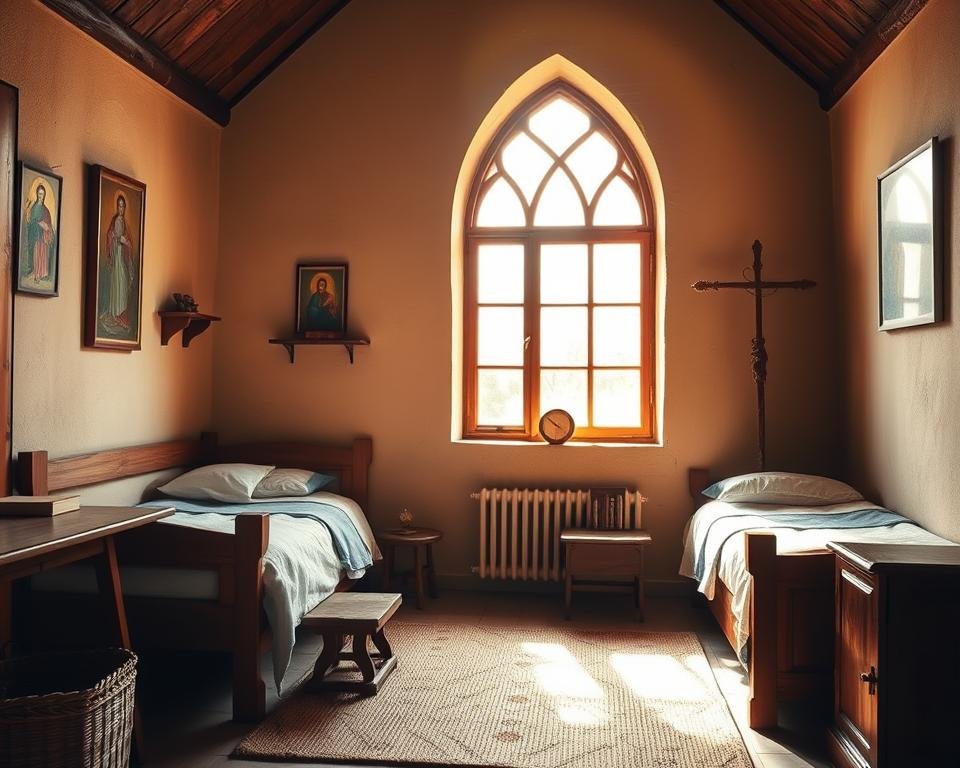
Buddhist Monasteries and Temples
Buddhist monasteries and temples constitute a significant part of the monastic landscape in the United States. Communities associated with the Zen, Tibetan, and Theravada traditions offer spaces for meditation and spiritual practice. They include meditation halls and outdoor gardens with Buddha statues designed to create a peaceful atmosphere conducive for contemplation.
Christian Monasteries and Abbeys
In the United States, Christian Monasteries and Abbeys have existed from the onset of European settlement. These communities are predominantly of the Catholic or Orthodox denominations and are characterized by their liturgical, devotional, and contemplative practices. Most of the communities are self-sufficient and are able to cultivate their own farms and gardens.
Interfaith and Ecumenical Communities
In the United States, the interfaith and ecumenical monastic communities are a recent innovation in American monasticism. These communities are comprised of people from different religions and are intended to encourage discourse and understanding among varying religions. These communities often practice a hybridized monasticism by integrating different religious practices into one.
Secular Contemplative Communities
In the United States, secular contemplative communities focus on another dimension of monasticism. These communities are not centered on a specific religion, however, they do promote and encourage the practice of contemplation and the deepening of one’s spirituality. Such communities offer the opportunity to people that are in search of a deep and more contemplative existence.
The following table provides additional insight into the varied monastic communities that exist in the United States:
| Type of Community | Spiritual Tradition | Key Features |
| Buddhist Monasteries | Buddhism (Zen, Tibetan, Theravada) | Meditation halls, Buddha statues |
| Christian Monasteries | Catholic, Orthodox Christianity | Liturgical worship, contemplative lifestyle |
| Interfaith Communities | Multi-religious | Dialogue, mutual understanding |
| Secular Contemplative Communities | Non-denominational | Contemplative practices, spiritual growth |
Practical Considerations When Creating a Home for Monks
Like any other form of community, a monastic community requires the planning of complex networks of relationships, and in this case, a community of priests and monks.
Legal Considerations and Zoning Requirements
In the planning of a home for monks, clerical monks and clergy must also determine the appropriate legal and zoning frameworks. Most of the time, planning a monastic community requires a legal understanding of land use, building regulations, and zoning regulations, which includes the acquisition of all relevant bureaucratic approvals.
Funding and Financial Sustainability
Constructing and sustaining a monastic community requires space, which comes at a set expense, which can be offset by donations, grants, or community revenue. These elements can be expected and offset by a sustainable community model.
Community Support and Engagement
Consolidating support from the local community is essential for the success of home for monks. Outreach programs and community educational and volunteer activities accomplish this goal. Virtually any interaction at this level promotes good community relations and mutual respect.
Governance Structures and Rules
For any system of order to function within the monastic community, clear governance infrastructures and rules must first be established and set for daily life, policies and procedures. Integration of guidelines covering the flow of decisions and order of disputes and their resolution is essential.
Practical considerations for monastic communities must be addressed for a conducive and sustainable ambience to surround spiritual development and growth.
Design of Spaces for Adaptation
Design policy for the home for monks must shift to the monastic way of life. Understanding monastic living and its community needs to align with the goals of contemporary living is important.
Existing Properties
For monastic living space, one of the techniques is to convert other properties such as residential buildings and even historically significant buildings.
Residential Conversions
Adaptations to the layouts of residential structures to include communal and meditation spaces can allow such buildings to be tailored home for monks. Consider the example of a large house; it can be adapted to a Buddhist monastery by incorporating a central meditation hall and a communal kitchen.
Preservation of the Past
The opportunity to create a functional monastic living space while preserving the past can be granted historic structures. With the proper restoration work, such buildings can regain their historic splendor and integrate contemporary conveniences.
New Developments
The design of a new monastic living space should consider multiple elements. It has to embody the ethos of the monastic community, alongside the integration of design principles that are sustainable and environmentally friendly.
Modernization of Monastic Living Spaces
There are basic modernizations that need to be incorporated while preserving the traditions of home for monks spaces. These include the integration of modern technologies and the provision of structural accommodations for the movement of people.
Constructive Use of Technology
Providing monastic community members with communication tools and spiritual resources can enhance their experience. For example, communities can have digital displays for virtual participation in meditation sessions and online tools for communal activities and home for monks.
Infrastructure for All
There should be no barriers to the use of monastic living spaces. The appropriate provision of physically accessible infrastructure such as ramps, bathrooms, and flexible sleeping areas should be incorporated to remove such barriers.
Important Monastic Homes in the United States
The United States harbors a range of monastic homes from the California mountains to the Kentucky hills. These home for monks attend to the spiritual needs of resident monks, offering a variety of tailored settings from the more communal homes to the more private retreats.
Tassajara Zen Mountain Center, California
Tassajara Zen Mountain Center is the first Zen monastery located in the Los Padres National Forest which is a California Zen monastery. It is a serene setting for monks and Zen practitioners to immerse in the Zen practice and is surrounded by nature.
Abbey of Gethsemani, Kentucky
The Abbey of Gethsemani is a Trappist monastery and was associated with Thomas Merton, a major spiritual writer. Here, in home for monks ,the monks pray, work, and meditate in contemplation following a Cistercian monastic tradition.
Deer Park Monastery, California
Located in Escondido, California, Deer Park Monastery is a Buddhist monastery that offers a serene environment for practicing and living monastically. It is part of the Plum Village Tradition established by Thich Nhat Hanh.
Holy Cross Abbey, Virginia
Holy Cross Abbey, located in Berryville, Virginia, is a Benedictine monastery that is open to retreat house guests. The Holy Cross Abbey community consists of praying and hospitality people and provides a venue for relaxation and contemplation.
Monastic communities are a rich part of monastic living in the United States and serve not just as the home for monks, but also as the centers for learning and spiritual growth.
Resources for Finding or Creating Monastic Homes
Monastic communities and monastic living is a way of life that is spiritually centered and takes a great deal of dedication and commitment. Resources are certainly important, but so is community.
Organizations Supporting Monastic Communities
The Monastic Alliance and the Contemplative Network are examples of organizations that serve monastic communities and provide great assistance and resources. Activities and resources for the development and sustainment home for monks include workshops and networking opportunities.
Architects Specializing in Spiritual Spaces
Monastic homes that fulfill the needs of the community and the spirit can be designed by architects specializing in spiritual or contemplative spaces. Smith & Co. is one of many firms that creates monastic architecture, blending the old and the new in respectful and innovative ways.
Monastic communities confront numerous obstacles to securing financing. Nonetheless, numerous grants and funding sources, such as the Spiritual Foundation Grant, assist in the funding of the construction and/or renovation of home for monks.
Monastic Alliance
- Networking and workshops for monastic communities.
- Guidance on establishing monastic life.
Smith & Co.
- Architects specializing in spiritual spaces.
- Expertise in monastic architecture.
Spiritual Foundation Grant
- Funding for spiritual or monastic projects.
- Financial support for monastic homes.
Conclusion: The Future of Home for Monks in Modern America
As the world becomes more complex, the desire to live a more monastic life seems to only grow. A home for monks provides the chance for a person to give their life to spiritual practice, contemplation, and service. The many kinds of monastic communities in America, including Buddhist monasteries and Christian abbeys, shows the richness and variety of monastic living.
In modern America, the monastic way of life must find an equilibrium between upholding the underlying principles that have informed monastic life and adapting to contemporary realities, modern needs, and secular expectations. Monastic communities can flourish by integrating sustainable design principles, adaptable built environments, and proactive community involvement. Home for monks interest should be accompanied by appropriate levels of support and resource provision to participants and prospective community joiners.
The potential for supportive and novel housing arrangements for monks relies on the assimilation of monastic living history and synthesis of its core attributes and practical arrangements. Over time, the capacity of monastic communities to pivot and shift will be crucial to maintaining their position within the spiritual landscape of America.
FAQ
What are the key elements to consider when designing a monastic living space?
The key elements to take into account when designing a home for monks space include the arrangements for meditation and prayer, spaces for communion and community gatherings, solitary quarters, and other sustainable design components that offer an adaptable environment for spirituality.
In what way do the different monastic traditions influence the design of their living arrangements?
The design of a home for monks format is influenced by different spiritual practices, cultural traditions, and architecture of a given monastic tradition, be it Buddhist, Christian, or interfaith.
What practical considerations need to be taken into account when trying to establish a new monastic community?
In establishing a new monastic community, practical considerations encompass laws and zoning regulations, acquisition and fiscal viability of funding, community support and engagement, and construction of appropriate governing frameworks encompassing rules and bylaws to achieve functional harmony and cooperation.
Is it possible to convert existing properties into monastic living spaces?
Convert existing properties into home for monks spaces? Certainly! Adaptations of residential and even some historic properties can be structured to cater to living spaces of monastic communities, including meditation, communal, and private spaces.
In what ways, and to what extent, do monastic communities cope with the need to accommodate contemporary life?
Coping with contemporary life and modernization in the communities revolves around the integration of functional technologies, modern accessibility, and contemporary sustainable constructs—all of which can be incorporated around and throughout the community, while still being emblematic of spiritual heritage.
What has been or can be used in the effort of locating or establishing home for monks?
In locating or establishing monastic homes, there exist funding opportunities, grants targeted to support monastic communities, specialized architects in spiritual spaces, and community-established monastic communities.
Are there any notable examples of monastic homes in the United States?
There are several home for monks in the United States that feature unique characteristics and contributions to monastic living. Among these are Tassajara Zen Mountain Center and Deer Park Monastery in California, Abbey of Gethsemani in Kentucky, and Holy Cross Abbey in Virginia.
